You have probably heard that ceramic coating creates a hard, glossy and water-repellent layer over your car’s paint. But what actually happens when a ceramic coating is applied to the surface?
Is it really a layer of ceramic? How does it bond with the paint? Why does water form droplets and roll away? And what makes newer formulations containing graphene and borophene different from traditional SiO₂-based coatings?
The answers lie in chemistry.
A modern ceramic coating for cars is a carefully formulated liquid coating that undergoes a chemical transformation after application. Its ingredients react, bond and cure to form a highly durable protective layer over the vehicle’s clear coat.
This guide explains the science behind car ceramic coating, the materials used to formulate it, how these materials protect your paint and why newer technologies are changing what ceramic coatings can offer.
Table of contents
- What Is Ceramic Coating and What Is It Made Of?
- How Does Ceramic Coating Bond With Car Paint?
- The Role of SiO₂ in Ceramic Coatings
- Graphene and Borophene: The Evolution of Ceramic Coatings
- How Ceramic Coating Protects Your Car’s Paint
- What Ceramic Coating Can and Cannot Do
- Why Formulation and Professional Application Matter
- Why Choose CarzSpa for Ceramic Coating?
- Conclusion
- Frequently Asked Questions
What Is Ceramic Coating and What Is It Made Of?
A ceramic coating is not simply a liquid version of glass that is poured onto your car. It is a chemically engineered coating made using compounds that can react and form a durable network on the vehicle’s surface.
Most automotive ceramic coatings are based around silicon dioxide (SiO₂) or silicon-containing compounds such as silanes and siloxanes. Depending on the formulation, manufacturers may also use solvents, resins, catalysts, nanoparticles and other additives to control properties such as hardness, flexibility, curing time, gloss and chemical resistance.
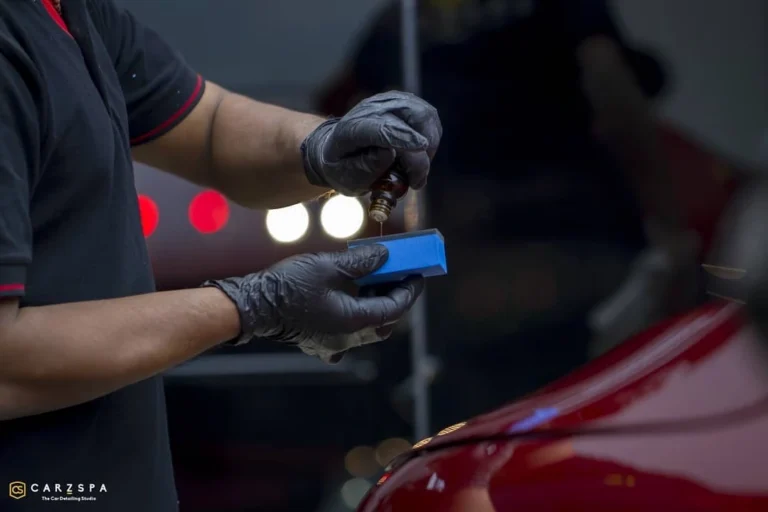
This is what makes car ceramic coating different from traditional waxes and many paint sealants. Wax primarily sits on the surface and provides temporary protection. A professionally applied ceramic coating undergoes a chemical curing process that creates a much more durable protective layer.
How Does Ceramic Coating Bond With Car Paint?
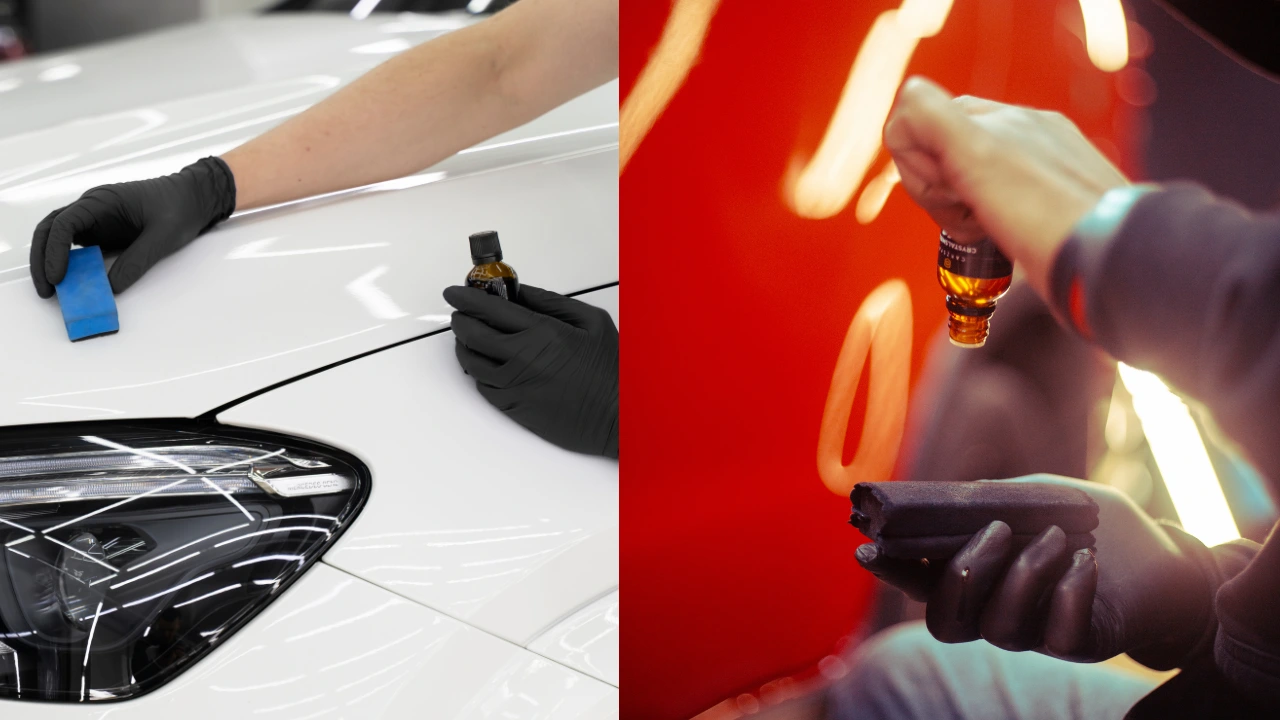
When the coating is first applied, it is a liquid. This allows it to spread across the clear coat and fill microscopic surface irregularities. As the carrier solvents evaporate and the reactive ingredients undergo hydrolysis and condensation reactions, the coating begins to cure. Hydrolysis helps convert certain silicon-containing compounds into reactive forms, while condensation allows them to connect and form a three-dimensional network.
During this process, the molecules form a cross-linked structure. Instead of remaining as a liquid sitting loosely on the surface, the coating becomes a thin, bonded protective layer.
The result is a protective layer that is strongly attached to the underlying surface. This bonded structure is responsible for many of the properties associated with car paint protection, including increased resistance to environmental contamination, easier cleaning, improved gloss and strong water repellency.
The Role of SiO₂ in Ceramic Coatings
Silicon dioxide, commonly written as SiO₂, is one of the most important materials associated with modern ceramic coatings.
SiO₂ is found naturally in materials such as quartz and sand, but automotive ceramic coatings do not simply contain powdered glass or sand. Instead, manufacturers use specially formulated silicon-based compounds that can form a protective network when the coating cures.
So, what does SiO₂ contribute?
Hardness and Surface Protection
Once cured, the ceramic coating creates a harder surface than many traditional protective products. This can improve resistance to light surface marring and environmental wear.
However, hardness should not be confused with scratch-proof protection. A ceramic coating can reduce the effect of certain minor contaminants and surface abrasion, but it cannot prevent deep scratches, stone chips or major physical impacts.
Hydrophobicity
One of the most noticeable characteristics of a good ceramic coating is its ability to repel water. The cured coating has a low surface energy, meaning water has less tendency to spread across the surface. Instead, it forms rounded droplets and can roll away more easily.
Chemical Resistance
A properly formulated coating can also improve resistance to many environmental contaminants, including acidic or alkaline residues, bird droppings and road grime. The coating acts as a protective layer between these contaminants and the vehicle’s clear coat.
Gloss and Smoothness
Because the coating forms a uniform layer over the prepared paint surface, it can enhance the visual depth and gloss of the finish. This is one reason why ceramic coating for cars has become popular among owners who want both protection and a long-lasting showroom appearance.
Graphene and Borophene: The Evolution of Ceramic Coatings
SiO₂ remains the foundation of many ceramic coating formulations, but the chemistry behind ceramic coatings has continued to evolve.
Graphene Coating
Graphene is a carbon-based material made up of carbon atoms arranged in a two-dimensional structure. When graphene is incorporated into a ceramic coating formulation, it can influence properties such as thermal behaviour, conductivity, durability and surface characteristics. However, the actual performance depends heavily on how graphene is incorporated into the formulation.
Borophene Coating
Borophene is a two-dimensional material made from boron atoms. It has attracted interest because of its unusual structural and physical properties. In advanced coating formulations, borophene can be combined with graphene and other ceramic chemistry to create a more sophisticated protective system. Advanced borophene + graphene formulations are designed to build upon the protective characteristics of conventional ceramic coatings while targeting greater surface durability, thermal resistance, hardness and longevity.
The important point is that these materials work as part of a formulation. The chemistry, concentration, dispersion, bonding system and manufacturing quality all matter.
How Ceramic Coating Protects Your Car's Paint
Now that we understand the chemistry, it becomes easier to understand the practical benefits.
A ceramic coating does not protect your vehicle by acting like a thick physical shield. Instead, it creates a thin, durable surface layer that changes how the paint interacts with its environment.
1. Protection Against Environmental Contamination
2. Makes Surface Water Repellent
3. Enhanced Gloss
4. UV and Environmental Protection
5. Long Durability
Unlike waxes that generally need frequent reapplication, professional ceramic coatings can protect for significantly longer periods. The actual lifespan depends on the coating chemistry, preparation, application, climate, driving conditions and maintenance. This is why the ceramic coating price should never be judged only by comparing the amount charged for the initial application.
What Ceramic Coating Can and Cannot Do
Ceramic coating is highly effective, but it is important to understand its limitations. Ceramic coating does not provide the same impact protection as a physical film.
A stone travelling at high speed can still chip the paint. A deep scratch can still penetrate the coating and clear coat. A collision can cause substantial damage regardless of whether the vehicle has ceramic coating.
If your primary concern is stone chips and physical impact, paint protection film is more appropriate. If your priority is gloss, hydrophobicity, easier maintenance and protection against environmental exposure, ceramic coating can be an excellent solution.
In some cases, both technologies can work together, with PPF providing impact protection and ceramic coating on PPF adding hydrophobicity, gloss and easier maintenance over suitable surfaces.
Why Formulation and Professional Application Matter
Two ceramic coatings can both claim to contain SiO₂ and still deliver very different results. Why?
Because the chemistry behind a coating is far more complex than one ingredient. The type of reactive compounds used, their concentration, cross-linking behaviour, solvents, additives, curing characteristics and manufacturing quality all influence the final coating.
Application is equally important.
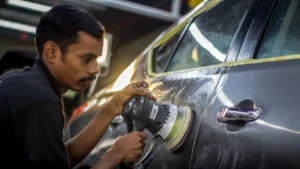
Before coating, the paint must be thoroughly washed, chemically decontaminated and, where required, corrected and polished. Any remaining contamination or surface defects can become locked beneath the coating.
The applicator must also understand flash times, ambient temperature, humidity, panel size, coating thickness and curing requirements. Applying too much product or allowing it to cure incorrectly can result in high spots, streaks or unevenness.
When comparing the ceramic coating price, it is therefore important to consider the preparation, paint correction, coating formulation, number of layers where applicable, warranty and aftercare support, not just the product name.
Why Choose CrystalShield Coatings at CarzSpa?
When you invest in ceramic coating, you are investing in both the coating technology and the expertise required to apply it correctly.
CrystalShield Coatings includes an advanced range of nano-ceramic car paint protection coatings, formulated using ultrasonic dispersion technology for better bonding of SiO₂ and resins, to provide a combination of gloss, hydrophobicity, surface protection and durability.
Their coatings include the Trinity 9H ceramic coating, Pentagon Impact graphene coating and the one-of-a-kind Apex borophene + graphene coating.
For customers looking for the best ceramic coating brand, CarzSpa offers exclusive access to CrystalShield Coatings, available only through CarzSpa.
With nearly two decades of detailing experience and 150+ CarzSpa Detailing Studios across India, CarzSpa combines professional detailing expertise with advanced paint protection technologies.
The focus is not simply on applying a coating to a car. Proper surface preparation, paint correction, application and curing are essential to achieving the intended performance.
This approach is particularly important when considering the ceramic coating for cars price. A professional application includes much more than the liquid coating itself.
With CarzSpa’s Pan-India network, customers can also access professional ceramic coating application and ongoing detailing expertise through its extensive studio network.
For car owners comparing the best ceramic coating for cars, the combination of advanced CrystalShield technology, professional application and detailing expertise makes CarzSpa a complete car protection destination.
Conclusion
The science behind ceramic coatings is ultimately the science of chemistry, bonding and surface protection.
From SiO₂-based formulations to newer graphene and borophene technologies, modern coatings are engineered to create a durable protective layer over the vehicle’s clear coat. This layer changes how water, dirt, contaminants and the environment interact with the paint.
But the coating itself is only part of the equation. Formulation quality, surface preparation, professional application, curing and maintenance all influence the final result.
That is why choosing the right technology and the right detailing professional matters. For owners looking for long-term gloss, hydrophobicity and everyday car paint protection, a professionally applied ceramic coating can be a valuable investment in maintaining the appearance of their vehicle.
Frequently Asked Questions
1. Is ceramic coating actually made of ceramic?
Ceramic coatings are actually made of silicone dioxide and resins. Additionally, materials like graphene and borophene are infused too.
2. Is graphene better than SiO₂ ceramic coating?
Graphene coating is definitely better than regular SiO₂ ceramic coating because it provides better dust and water repellency and chemical resistance.
3. What is borophene ceramic coating?
The two-dimensional boron-based material, borophene, is infused with graphene and silicone dioxide to form an advanced coating formulation.
4. Does ceramic coating prevent scratches?
No. Ceramic coating can improve resistance to minor surface wear, but it is not scratch-proof or impact-proof.
5. Is ceramic coating worth the price?
For owners who want long-term gloss, hydrophobicity, easier cleaning and additional environmental protection, professional ceramic coating can be a worthwhile investment.
Share: