Your EV is built for the future. But the roads you drive on are very much in the present, with potholes, rocks, pebbles and loose gravel. And not to forget the monsoon grime, bird droppings and tree sap. Your electric car’s outer body is as much in danger as a regular petrol or diesel car from these aggressors.
But why does it matter to have PPF for electric vehicles? You see, EV repairs are expensive. The body panels on modern electric cars are large and seamless, so a single deep scratch from rock chips, chemical reaction from bird poop or tree sap, and the fade from UV rays become glaringly visible and expensive to fix.
This is exactly why getting PPF coating on EVs is the simplest way to make sure it does not happen. In this blog, we are going to explain why PPF on EVs is a smart investment for the future.
Table of contents
- Why EVs Need PPF More Than ICE Cars
- The EV Paint Problem Nobody Mentions
- PPF and EV Design: A Perfect Match
- Protecting the Parts That Matter Most
- PPF, Resale Value and the Long Game
- PPF vs Ceramic Coating: What Should EV Owners Choose?
- How Much Does PPF Cost for an EV?
- Choosing the Best PPF for Your Electric Car
- Why Professional PPF Installation Matters
- Why CarzSpa for Your EV
- Conclusion
- Frequently Asked Questions
Why EVs Need PPF More Than ICE Cars
There is a common misconception that paint protection film is a luxury, something for supercars and weekend drives. For EV owners, it is the opposite. Here is why the case for PPF is actually stronger on an electric vehicle than on a traditional petrol car.
EVs cost more upfront. The average electric car in India commands a significant premium over its petrol counterpart. Higher investment means higher stakes when the paint gets damaged. A door-edge chip on a petrol hatchback might cost ₹2,000 to touch up. On a premium EV with a complex metallic or matte finish, the same repair can run into tens of thousands of rupees.
EVs depreciate differently. Resale value in the EV market is still finding its footing in India. First-generation buyers especially benefit from keeping their vehicles in immaculate condition, because a pristine EV commands a significantly better price than one with visible paint wear.
Modern EV paint is thinner. This is not a quality issue; it is chemistry. Most contemporary EVs use water-based paints, which are more environmentally responsible but also more susceptible to stone chips and surface marring than older solvent-based formulations. The paint needs a layer of defence that it was not born with.
The bottom line: everything that makes your EV worth owning also makes it worth protecting.
The EV Paint Problem Nobody Mentions
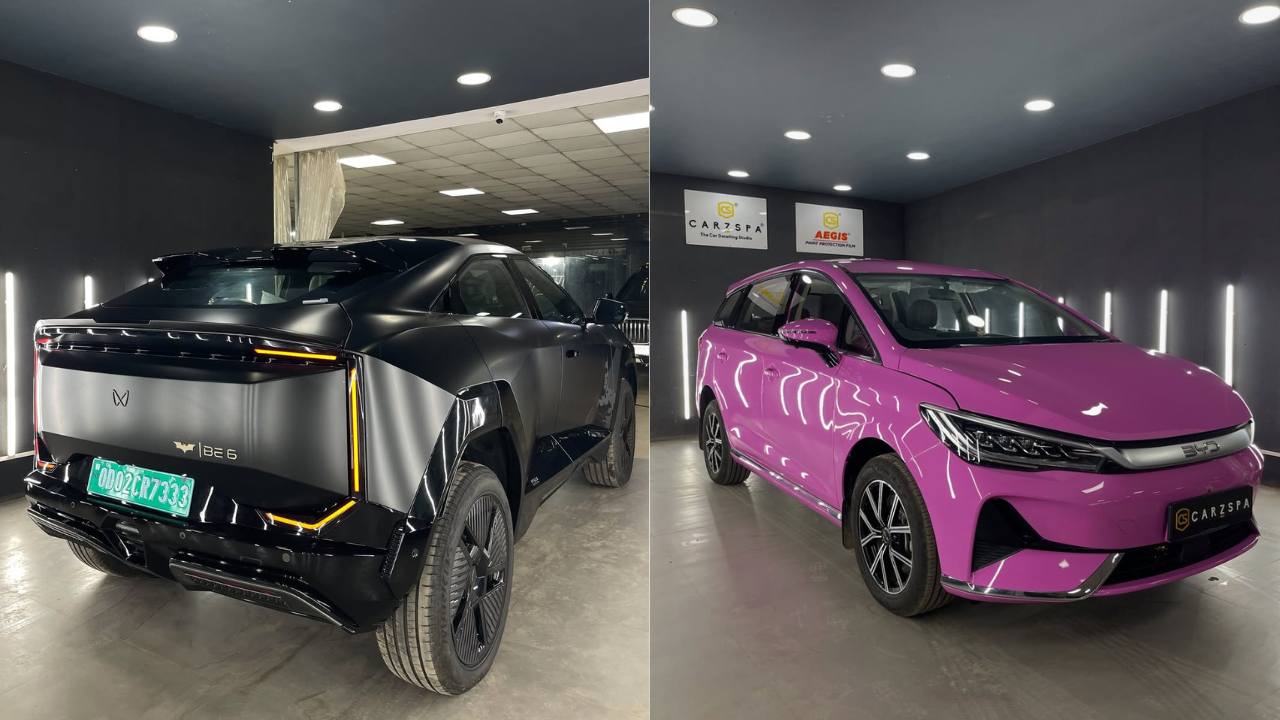
Walk around a Mahindra BE 6 or a Kia EV6 and you will notice something immediately: there are almost no character lines breaking up the body panels. Long, smooth, uninterrupted surfaces define modern EV design. This is intentional; clean aerodynamics improve range.
But those wide, flat panels are a detailer’s double-edged sword. Without lines and creases to draw the eye, every swirl mark, every minor scratch and every water spot is instantly visible. On a petrol car with busy body styling, small paint imperfections get lost. On an EV, they announce themselves.
Add to this the Indian driving reality: potholes, construction dust, highway gravel and six months of monsoon abuse. A PPF car is a car that has a fighting chance against all of it. Without protection, those flawless panels will bear the brunt of every aspect of Indian road conditions within a year.
This is not a hypothetical. It is what happens to unprotected EVs in the real world.
PPF and EV Design: A Perfect Match
Modern EVs come with design features that are visually striking but inherently vulnerable. Car paint protection through PPF addresses each of these specific vulnerabilities directly.
| EV Design Feature | EV Design Feature | How PPF Helps |
|---|---|---|
Flush door handles | Collect grit and moisture, causing edge chips | PPF wraps the handle recess and the surrounding area |
Panoramic glass roof edges | Prone to mineral deposits and micro-scratches | Film applied to exposed edges seals against damage |
Large front hood | Maximum exposure to stone chips at highway speed | Full-front PPF absorbs impact before paint does |
Side sills and rocker panels | Constant road spray and debris | Lower-body PPF takes the hits, paint stays clean |
Rear bumper | Luggage scuffs and key scratches | Self-healing PPF erases minor marks on contact |
The self-healing property of quality PPF is particularly valuable for EV owners. Surface scratches from car park encounters, brush contact and light abrasion simply disappear with heat, either from sunlight or warm water. The car looks perpetually new without any intervention.
Protecting the Parts That Matter Most
Beyond the obvious body panels, EVs have specific areas that deserve targeted PPF attention.
The Charging Port
Every EV owner plugs in multiple times a week. The area around the charging port flap takes repeated contact and over time, the paint around it accumulates micro-scratches from the cable connector and repeated hand contact. A targeted PPF application around the charging port is a small investment that prevents a cumulative problem.
The Underbody and Battery Casing
The battery pack of an EV runs the full length of the car’s floor, sitting close to the road surface. Indian roads, with their potholes, construction debris and monsoon flooding, make this area a constant target for stone chips and moisture. While PPF is typically applied to painted surfaces, the protective casing around battery modules benefits from specialist underbody protection treatments that work on the same principle.
The Frunk and Boot Edges
Both the front storage area (frunk) and the rear boot are opened and closed daily. The exposed paint on the loading edges chips and scratches faster than almost any other surface on the car. A strip of PPF along these edges is one of the most practical and cost-effective applications on any vehicle.
PPF, Resale Value and the Long Game
The EV market in India is maturing fast. Buyers shopping for used EVs in 2025 and 2026 are far more sophisticated than the first wave of early adopters. They inspect carefully and the paint condition is one of the first things they assess.
A used EV with paint that looks three years old will sell for considerably less than one that looks like it just rolled out of the showroom. PPF is the mechanism that makes the second scenario possible. It is not an expenditure; it is deferred depreciation.
Consider the numbers. A full-body PPF coating costs less than a full repaint. A professional repaint on a premium EV can run anywhere from ₹80,000 to ₹2,50,000, depending on the vehicle and the extent of damage. PPF eliminates the need for that repaint for the life of the film, typically 7 to 10 years with a quality product.
The maths strongly favours protection over repair.
PPF vs Ceramic Coating: What Should EV Owners Choose?
This is the most common question at any CarzSpa studio and the answer is almost always: both, applied in the right sequence.
PPF and ceramic coating do different jobs. PPF is a physical barrier, a thick, self-healing polyurethane film that absorbs stone chips, scratches and road debris before they reach the paint. Ceramic coating is a chemical bond that adds hydrophobicity, UV resistance and a mirror-like gloss to whatever surface it is applied over.
When ceramic coating is applied over PPF, you get the protection of the film with the maintenance ease and visual depth of ceramic. Bird droppings, tree sap and hard water bead up and roll off instead of etching the surface. Under the Indian sun, UV oxidation, which fades paint and yellows older clear coats, is stopped before it starts.
For EV owners who want one comprehensive answer: PPF on the high-impact zones (full front, side sills, door edges, charging port area) and ceramic coating over the full car is the combination that gives you maximum protection with minimum maintenance.
How Much Does PPF Cost for an EV?
The PPF cost in India ranges anywhere from ₹62,000 to ₹2,80,000 for a full body coverage, depending on the film grade, type and your vehicle’s size.
| Product | Warranty | Per Sqft | Small | Mid | Large | XL |
|---|---|---|---|---|---|---|
Core | 3 Years | ₹325/sqft | ₹61,750 | ₹71,500 | ₹81,250 | ₹91,000+ |
Armor | 5 Years | ₹400/sqft | ₹76,000 | ₹88,000 | ₹1,00,000 | ₹1,12,000+ |
Black | 5 Years | ₹400/sqft | ₹76,000 | ₹88,000 | ₹1,00,000 | ₹1,12,000+ |
Matt | 5 Years | ₹400/sqft | ₹76,000 | ₹88,000 | ₹1,00,000 | ₹1,12,000+ |
SPX | 7 Years | ₹500/sqft | ₹95,000 | ₹1,10,000 | ₹1,25,000 | ₹1,40,000+ |
Matt Pro | 7 Years | ₹500/sqft | ₹95,000 | ₹1,10,000 | ₹1,25,000 | ₹1,40,000+ |
Prism (Colour) | 7 Years | ₹845/sqft | ₹1,61,000 | ₹1,87,000 | ₹2,12,500 | ₹2,38,000+ |
Xceed | 10 Years | ₹650/sqft | ₹1,23,500 | ₹1,43,000 | ₹1,62,500 | ₹1,82,000+ |
Ultra 250 | 12 Years | ₹850/sqft | ₹1,61,500 | ₹1,87,000 | ₹2,12,500 | ₹2,38,000+ |
Eternal 300 | Lifetime | ₹1,000/sqft | ₹1,90,000 | ₹2,20,000 | ₹2,50,000 | ₹2,80,000+ |
Eternal 400 | Lifetime | ₹1,105/sqft | ₹2,10,000 | ₹2,40,000 | ₹2,65,000 | ₹2,80,000+ |
| Coverage | What It Includes | Best For |
|---|---|---|
Front Protection Package | Hood, bumper, fenders, mirrors, headlights | Daily city drivers are focused on the stone chip risk |
Partial Body | Front package + door edges + rocker panels | Balanced protection for mixed city/highway use |
Full Body | Every painted surface on the car | Long-term owners, premium EVs, resale focus |
For detailed PPF coating price information specific to your vehicle and coverage requirement, CarzSpa provides transparent, no-obligation quotes at any of its 150+ studios across India and Nepal.
Choosing the Best PPF for Your Electric Car
Not all paint protection films are equal. The market has a wide range of products and the difference between a budget film and a premium one shows within the first two monsoon seasons.
When evaluating the best PPF brands for your EV, look for these qualities:
- Self-healing top coat: Surface scratches must disappear with heat. If a film does not self-heal, it is a generation behind.
- Optical clarity: The film should be invisible on the paint, with no orange peel texture, no yellowing over time.
- UV stability: Under the Indian sun, a poor-quality film yellows within 2 to 3 years, making your paint look worse than if it had no protection at all.
- Hydrophobic top layer: Water, mud and contaminants should bead off rather than sit on the surface.
- Warranty: A quality film comes with a pan-India warranty that is honoured at multiple authorised studios, not just the installer.
Aegis Films, CarzSpa’s proprietary PPF brand, is engineered to meet all of the above criteria. Available in clear, matte and the high-performance XG Series, it is calibrated specifically for Indian climate conditions, from coastal humidity to desert heat to monsoon flooding. Every Aegis Films installation at CarzSpa carries a comprehensive pan-India warranty.
Why Professional PPF Installation Matters
Paint protection film is not a sticker. It is a precision material that needs to be cut, stretched and heat-formed around complex curves, door edges, flush handles and panel gaps, without lifting, bubbling or leaving visible seams. On an EV with large, uninterrupted panels, any installation flaw is immediately obvious and far harder to correct than on a car with busy body lines to break up the view.
Bad installation introduces problems like lifting edges, bubbling and silvering near curves, visible cut lines across panels, which mainly starts with improper surface prep.
Expert installers like the teams at CarzSpa are trained in EV-specific application, they know where to make relief cuts on flush door handles, how to wrap charging port edges cleanly and how to work around ADAS cameras and sensors without compromising the film or the vehicle’s safety systems.
Why CarzSpa for Your EV
CarzSpa has been in the car care business for over two decades. In that time, the automotive landscape has changed enormously and our studios have evolved with it.
- EV-trained professionals: Our teams understand EV architecture, from flush door handle detailing to safe handling around high-voltage underbody areas. Your EV is not treated as a standard car.
- Aegis Films PPF: As the exclusive installer of our own Aegis Films brand, CarzSpa controls quality from film production to installation. There is no distributor in between.
- Zero franchise fee, zero royalty model: Every CarzSpa studio operates to the same standard because the model is built for quality, not volume-based economics.
- 150+ studios across India and Nepal: Your pan-India warranty is backed by a real network. If you move cities or need a warranty claim, CarzSpa is there.
- Transparent pricing: No surprises. PPF coating price is quoted upfront, with coverage options clearly explained before any work begins.
Conclusion
An electric vehicle is a deliberate investment. It reflects a considered view of how you want to drive and what you are willing to spend to do it right. PPF is the same philosophy applied to paint.
It is not a cosmetic vanity. It is what protects a ₹30 lakh decision from a random stone on the highway. It is what keeps your EV commanding a strong resale price three years from now. It is what makes the difference between a car that ages well and one that doesn’t.
The paint protection film goes on once. The protection lasts for years. That is the investment case in one sentence.
Frequently Asked Questions
1. Is PPF worth it for an electric vehicle?
Yes. EVs have large, smooth panels that show damage easily, use thinner water-based paint and cost more to repair. PPF protects all three vulnerabilities and pays for itself in avoided repair costs.
2. How much does PPF cost for an EV in India?
It varies by coverage and vehicle size. You can check the current PPF cost on the Aegis Films website or get a quote at any CarzSpa studio across India.
3. Should I get full-body PPF or just the front?
Front protection covers the highest-impact zone. Full-body PPF makes sense for premium EVs, long-term owners and anyone focused on maximising resale value. CarzSpa can help you choose based on your usage.
4. Which is the best PPF brand for an EV in India?
Look for self-healing, UV-stable, optically clear films with a pan-India warranty. Aegis Films is one of the best PPF brands engineered specifically for Indian climate conditions.
5. Can PPF be applied around EV-specific features, such as flush door handles?
Yes. Professional installers cut and apply PPF precisely around flush handles, charging ports and camera housings. CarzSpa technicians are trained in EV-specific PPF application.