Your car’s paint is under constant attack. Stone chips on highways, bird droppings in parking lots, UV radiation and the unavoidable dust and grime of Indian roads, all of it chips away at your vehicle’s finish every single day.
A paint protection film (PPF) is the most effective physical shield available for your car’s paint. Unlike wax or ceramic coating, PPF is a physical layer; it absorbs impacts, self-heals minor scratches and protects the paint beneath from direct damage. But not all PPFs are the same and the wrong choice can cost you both money and paint quality.
This comprehensive guide by the car paint protection experts at CarzSpa Detailing Studios covers everything you need to know about the types of PPF available in India, how they differ by material, finish, thickness and self-healing technology and exactly how to choose the right one for your car, driving habits and budget.
Table of contents
- Not All PPFs Are the Same
- Types of PPF by Material
- Types of PPF by Appearance
- Types of PPF by Thickness
- Types of PPF by Warranty
- Instant Self-Healing vs. Delayed Self-Healing
- PPF vs. Ceramic Coating vs. Vinyl Wrap
- Recommended PPF coverage zones
- How Much Does PPF Cost in India?
- Aegis PPF by CarzSpa – The Complete Range
- Why Choose Aegis PPF by CarzSpa
- Concluding Thoughts
- Frequently Asked Questions
Not all PPFs are the same
With countless brands and options, choosing the right PPF for cars can be overwhelming. Understanding the various types and their unique characteristics is essential to make an informed decision.
PPF for cars vary in the base material they are made from, the finish they create, how thick they are, how long they are warranted for and how quickly they heal from scratches. Each of these factors affects real-world performance on Indian roads, where summer temperatures can exceed 45°C, monsoon humidity puts films under sustained stress and daily city driving brings constant swirl marks and stone chips.
Let’s explore the different types of PPFs in detail to help you identify the perfect match for your car’s protection and aesthetic.
Types of PPF by Material
TPU-Based PPF
Thermoplastic Polyurethane (TPU) is a premium material renowned for its exceptional properties. Its combination of strength, flexibility and optical clarity makes it the ideal base for a high-quality PPF coating. TPU-based films offer superior resistance to scratches, chips and environmental aggressors. Their elasticity allows them to conform seamlessly to complex body curves during installation and their self-healing top coat allows minor scratches to disappear with heat exposure.
TPH Films
TPH is a hybrid of TPU and PVC (Polyvinyl Chloride) and most TPH films originate from low-cost manufacturing facilities. They contain a high proportion of plasticizer to achieve transparency and softness, but over time, this plasticiser leaches out, causing the film to yellow, crack and leave adhesive residue on your paint upon removal. TPH films are often sold at significantly lower prices and may initially appear comparable to TPU films. However, the long-term damage they can cause to your paint and the difficulty of removal once degraded, make them a false economy. When evaluating PPF options, always confirm the base material with your installer before proceeding.
Key warning signs of a TPH film being misrepresented as TPU:
- No clear material disclosure from the installer
- Unusually low price for “full coverage”
- No warranty or a very short one (under 2 years)
- No recognisable brand name on the film roll
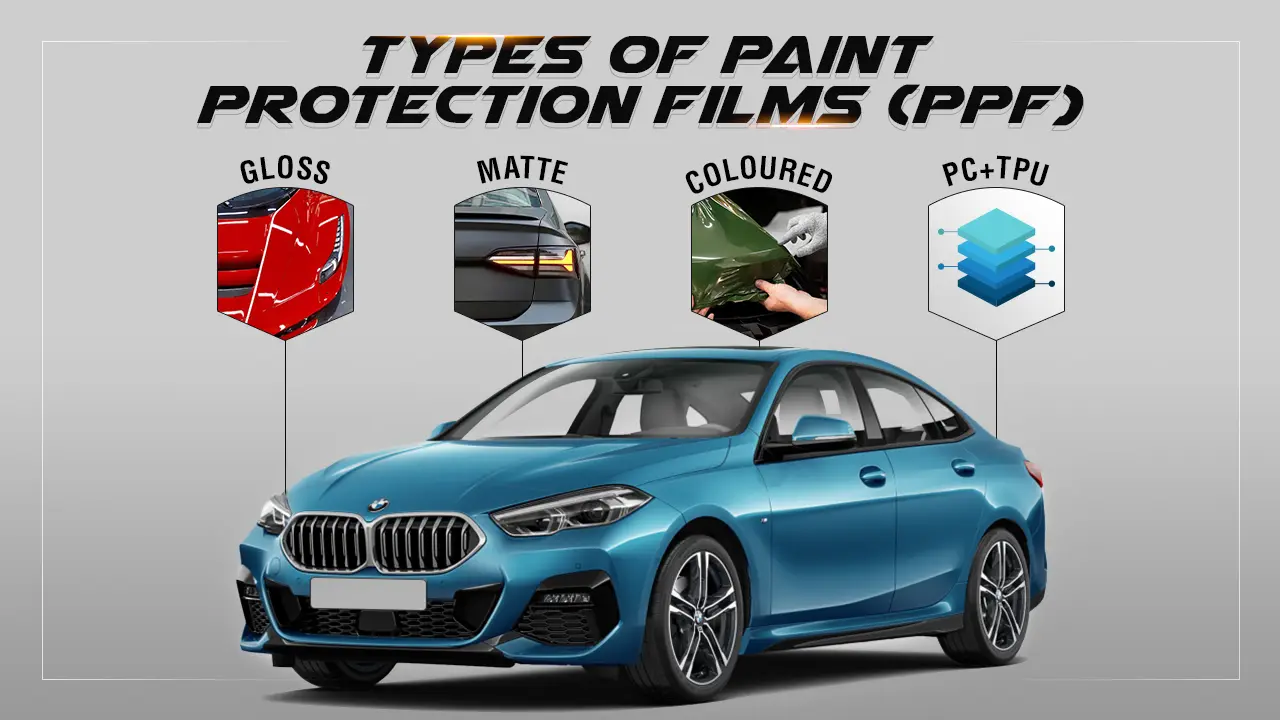
Polycarbonate TPU PPF
Building on the strengths of standard TPU, a new generation of PPF for cars have been developed by incorporating Polycarbonate into the base material. This innovative blend, produced through a rigorous triple extrusion process, delivers exceptional clarity, gloss and impact resistance that surpasses conventional TPU films.
Aegis PPF by CarzSpa has pioneered the Polycarbonate TPU PPF in India and launched it under the name Aegis XG Series. It provides superior scratch resistance, hydrophobicity and self-healing properties, specifically engineered to withstand India’s harsh driving conditions and extreme temperature range.
Types of PPF by Appearance
Gloss PPF
Gloss PPF is a popular choice for car owners in India seeking to protect their vehicle’s paint while maintaining a showroom-like shine. This type of PPF for cars is designed to prevent everyday wear and tear, shielding it from scratches, dirt, tree sap and bird droppings.
With a typical thickness of 185–210 microns, gloss PPFs provide robust everyday protection against scratches, bird droppings, tree sap and road grime. They are suitable for all vehicle types, from daily-use hatchbacks to luxury sedans and SUVs.
Aegis Clear PPF by CarzSpa, available in SPX, Armor, Xceed, Ultra 250 and the XG Series, delivers some of the highest gloss levels available in the Indian market.
Matte PPF
Matte PPF is a popular choice for car owners in India who prefer a more understated and sophisticated look. Unlike glossy PPF, matte PPF provides a velvety, non-reflective finish that adds a touch of elegance to your vehicle.
This type of PPF on cars is an excellent, durable option that shields it from dust, swirl marks and minor scratches. It offers a practical and stylish solution for those who value both protection and aesthetics.
A matte-finish PPF typically has a thickness of 190 to 250 microns, providing a robust layer of protection without compromising the vehicle’s appearance. It’s suitable for a wide range of cars in India, from compact hatchbacks to luxury sedans.
If you’re looking to give your car a unique and stylish look while also protecting its paint, matte PPF is an excellent choice. Aegis by CarzSpa has devised the perfect product for this range, called Aegis Matt, which adds to the luxurious look of the car.
Coloured PPF
Coloured PPF is an innovative and versatile paint protection product for car lovers who want to flaunt their personality and style through the colours and shades on their cars, while protecting its factory paint. Unlike vinyl wraps, which can be prone to tearing, coloured PPF is a specially engineered film that adheres directly to the paint, providing a seamless and durable layer of protection.
Coloured PPF is available in solid shades, metallic finishes and increasingly in colour-shifting and glow-in-the-dark variants, making it the choice for car owners who want both expression and protection. Aegis PRISM by CarzSpa offers 50+ colour options, giving car owners the widest selection of coloured PPF available from any single brand in India.
A coloured PPF typically has a thickness of 190 microns, offering a robust layer of protection without compromising the vehicle’s aesthetics. It’s suitable for a wide range of cars in India, from compact hatchbacks to luxury sedans. To cater to this vibrant community of car lovers, Aegis by CarzSpa has PRISM, the brand’s landmark coloured PPF with 50+ colour options.
Sunroof Protection Film
Sunroof films serve a distinct purpose from body PPF; they are primarily designed for heat rejection and UV protection rather than impact absorption. A quality sunroof film significantly reduces the infrared heat entering through the glass, protects occupants from UV exposure and shields the surrounding painted frame from fading and bird-dropping damage. Aegis Sunroof for Cars by CarzSpa offers up to 93% Infrared Rejection Rate, making it one of the most effective sunroof protection solutions available in India.
For a detailed guide on sunroof protection, see our dedicated Aegis Sunroof PPF page.
Types of PPF by Thickness
PPFs are available in thicknesses typically ranging from 150 microns (6 mil) to 400 microns (16 mil). A thicker PPF generally offers greater impact protection, but thickness alone does not determine quality. The material grade and top coat technology matter equally.
Key layers and their functions
| Layer | Typical Thickness | Function |
|---|---|---|
Self-Healing Top Coat | 15–20 microns | Heals minor surface scratches with heat |
TPU/TPH Base Layer | 100–350 microns | Primary protective layer; determines overall thickness |
Pressure-Sensitive Adhesive | 25–35 microns | Bonds the film to the paint without damage |
Practical guidance by driving profile:
- City driving, light use: 185–210 microns (e.g., Aegis SPX or Armor) provides adequate protection
- Mixed city and highway: 225–250 microns (e.g., Aegis Xceed or Ultra 250) recommended
- Heavy highway use or off-road: 300–400 microns (e.g., Aegis Eternal 300 or 400) for maximum impact resistance
Types of PPF by Warranty
PPF warranties vary significantly based on the quality of the TPU material and the manufacturing process. Higher-grade aliphatic TPU offers superior resistance to yellowing, cracking and delamination, resulting in longer, more reliable warranty coverage.
What to look for in a PPF warranty?
- Duration: Reputable brands offer 5–10-year or even lifetime warranties on premium TPU films
- Coverage: Warranty should cover yellowing, bubbling, cracking and delamination, not just manufacturing defects
- Conditions: Verify whether the warranty requires installation by certified technicians (it almost always should)
- Brand backing: A warranty is only as strong as the brand behind it. Choose brands with a verifiable track record in India
Instant Self Healing vs Delayed Self Healing
Many PPFs feature self-healing properties, allowing minor scratches to disappear with exposure to heat. However, self-healing technology can vary in its speed and effectiveness.
Soft Self-Healing Coat
- Instant Repair: Minor scratches heal quickly, often within minutes.
- Scratch Susceptibility: May be more prone to scratches due to the softer material.
- Faster Oxidation: This can oxidise more rapidly, leading to a yellowish appearance over time.
Hard Self-Healing Coat
- Delayed Repair: Requires heat (hot water or heat gun) to activate the self-healing process.
- Scratch Resistance: Offers greater resistance to scratches due to the harder material.
- Slower Oxidation: Maintains a clearer appearance for a longer period, reducing the risk of yellowing
With summer temperatures regularly exceeding 40°C in most Indian cities, soft coat films can activate prematurely and degrade faster. This is why all Aegis Films by CarzSpa use a hard top coat, designed specifically for the subcontinent’s climate.
PPF vs. Ceramic Coating vs. Vinyl Wrap
One of the most common questions asked by car owners evaluating paint protection options is how PPF compares to ceramic coating and vinyl wrap. These three products are fundamentally different in what they do and in many cases, they are best used together rather than as alternatives.
| Feature | PPF | Ceramic Coating | Vinyl Wrap |
|---|---|---|---|
Primary function | Physical impact protection | Chemical & UV protection | Colour change/aesthetics |
Protects against stone chips | ✅ Yes | ❌ No | ❌ Limited |
Self-healing | ✅ Yes (premium TPU) | ❌ No | ❌ No |
UV protection | ✅ Yes | ✅ Yes | ✅ Partial |
Hydrophobic properties | ✅ Yes | ✅ Yes (superior) | ❌ No |
Changes car colour | ✅ Coloured PPF only | ❌ No | ✅ Yes |
Thickness | 150–400 microns | 0.5–2 microns | 60–100 microns |
Durability | 7–10 years | 2–5 years | 3–5 years |
Cost (full car, India) | ₹60,000–₹2,00,000+ | ₹15,000–₹45,000 | ₹40,000–₹1,20,000 |
Best for | Long-term paint preservation | Gloss & easy maintenance | Temporary customisation |
Recommended PPF coverage zones
| Zone | Why It Needs Protection |
|---|---|
Bonnet | Constant stone chip exposure from highway driving |
Front bumper | Stone chips, parking scrapes and minor impacts |
Fenders | Road debris, wheel spray and narrow lane grazes |
Door edges | Car door dings in crowded parking lots |
Mirrors | Stone chips and car wash brush damage |
Headlights | UV yellowing and stone chip crazing |
Full body PPF is recommended for luxury vehicles, new cars, where preserving the factory paint is a long-term priority and for owners who frequently drive on highways or poorly maintained roads. It provides comprehensive protection and maximises resale value by keeping the original paint in factory-fresh condition.
For a detailed breakdown of PPF coverage options and pricing, visit our dedicated PPF Cost & Pricing Guide.
How Much Does PPF Cost in India?
PPF cost in India varies based on four primary factors: the film brand and grade, the coverage area, the vehicle size and the installer’s expertise. Here is a realistic price reference for 2025:
| Vehicle Type | Partial (Front End) | Full Body |
|---|---|---|
Hatchback (Swift, i20, Altroz) | ₹18,000–₹35,000 | ₹55,000–₹90,000 |
Sedan (City, Verna, Ciaz) | ₹22,000–₹40,000 | ₹70,000–₹1,20,000 |
Mid-size SUV (Creta, Seltos, Brezza) | ₹28,000–₹50,000 | ₹90,000–₹1,50,000 |
Full-size SUV (Fortuner, Endeavour, XUV700) | ₹35,000–₹65,000 | ₹1,20,000–₹2,00,000 |
Luxury/Premium vehicles | On request | ₹1,50,000–₹2,80,000+ |
Note: Prices are indicative and exclude GST. Installation complexity, city and film grade affect final pricing. Contact your nearest CarzSpa studio for an exact quote.
For a comprehensive step-by-step maintenance guide, visit our dedicated PPF Maintenance & Aftercare Guide.
Aegis PPF by CarzSpa - The Complete Range
Aegis Paint Protection Films by CarzSpa has something for every car owner and every budget. Developed with India’s road conditions and climate specifically in mind, all Aegis PPF products feature a hard top coat and aliphatic TPU base for sustained clarity and performance.
| Product | Type | Warranty | Thickness (Microns) | Tensile Strength (MPa) | Elongation @ Break (%) | ΔE |
|---|---|---|---|---|---|---|
Eternal 400 | Gloss PPF | Lifetime | 400 | 30 | 300 | <0.7 |
Eternal 300 | Gloss PPF | Lifetime | 300 | 30 | 300 | <0.7 |
Ultra 250 | Gloss PPF | 10 Years | 250 | 30 | 300 | <0.7 |
Xceed | Gloss PPF | 10 Years | 225 | 30 | 300 | <0.7 |
SPX | Gloss PPF | 7 Years | 210 | 27 | 300 | <1.0 |
Armor | Gloss PPF | 5 Years | 185 | 25 | 300 | <1.2 |
Matt (TPU) | Matte PPF | 5 Years | 185 | 30 | 300 | <1.0 |
Prism | Coloured PPF | 7 Years | 180-190 | 27 | 300 | <1.0 |
Why choose Aegis PPF by CarzSpa
- Made for India: The only PPF range developed with India’s climate, road conditions and car ownership patterns specifically in mind
- Polycarbonate-TPU XG Series: The most advanced PPF technology available globally, engineered in-house by CarzSpa’s R&D team
- Expert installation: 150+ studios across India with trained, certified technicians
- Comprehensive warranty: From a 5-year entry-level to lifetime coverage on the XG Series
- No royalty on range: From entry-level Armor to the flagship Eternal 400, one brand, one standard of quality
Concluding thoughts
In the world of car care, paint protection film (PPF) is a game-changer. By investing in a high-quality PPF, you’re safeguarding your car’s paint, preserving its value and enjoying the peace of mind that comes with knowing your investment is protected.
At Aegis by CarzSpa, we’re committed to providing the best PPF solutions tailored to your specific needs. Our team of experts is dedicated to delivering exceptional service and ensuring your complete satisfaction.
Don’t let the elements take a toll on your car’s paint. Choose Aegis by CarzSpa for the ultimate in PPF protection and experience the difference.
Frequently Asked Questions
Yes, PPF is worth it! It protects your luxury car from scratches and rock chips and keeps it looking brand new. Just ensure it’s suited for Indian weather for long-lasting protection.Aliphatic TPU-based PPF is generally considered the best type due to its superior durability, scratch resistance and UV protection.
2. Which is better PPF or TPU?
TPU is one of the components, using which PPFs are made and not a separate film applied on the car’s body. Aliphatic TPU-based PPFs are considered to be the best of the lot.
3. Which is better PPF or Teflon?
PPF is generally considered superior to Teflon coatings in terms of durability, scratch resistance and UV protection. PPF forms a protective layer that can withstand harsh conditions and maintain the original finish of the paint.
4. Which is better, ceramic or PPF?
PPF is generally considered a better choice than ceramic coatings for paint protection. PPF acts as a sacrificial layer, protecting the car’s paint against scratches and door dings apart from the usual gloss and UV protection, which ceramic coatings can’t.
5. What is the best paint protection film brand?
Aegis by CarzSpa is often considered one of the best PPF brands. Their XG Series, created using triple extrusion technology, offers exceptional durability, self-healing properties and a high-gloss finish.
Share: