
A panoramic sunroof is one of the best features a car can have. More light, more sky, more of that open, airy feeling on every drive. But here is the catch: that large glass panel sitting right on top of your car takes the full force of the sun, every single day. UV rays, infrared heat, bird droppings, dust and debris all land directly on it. And unlike your side windows, the sunroof has nowhere to hide.
Left unprotected, that premium feature starts working against you, heating your cabin, fading your interior and quietly racking up damage that is expensive to fix. The good news is that protecting your panoramic sunroof is not complicated. This guide walks you through everything you need to know about installing a sunroof protector for cars.
Table of Contents
- Why Sun Exposure is Harmful for Panoramic Sunroofs
- Signs Your Sunroof Needs Protection
- Best Ways to Protect Your Panoramic Sunroof
- Benefits of Protecting Your Sunroof
- Common Mistakes to Avoid
- Legal Considerations in India for Sunroof film
- Professional vs DIY Protection
- To Conclude
- Frequently Asked Questions
Why Sun Exposure is Harmful for Panoramic Sunroofs
Most car owners think about sun damage in terms of paint fading or a hot cabin. But your panoramic sunroof is actually the most vulnerable part of your car when it comes to sun exposure, and for a very specific reason. It is horizontal. Your side windows shed debris, dust and water naturally because they are vertical. Your sunroof collects all of it. Every hour your car sits parked in the sun, that glass panel is absorbing concentrated solar energy from directly above. Here is what that does over time.
Heat Buildup Inside the Cabin
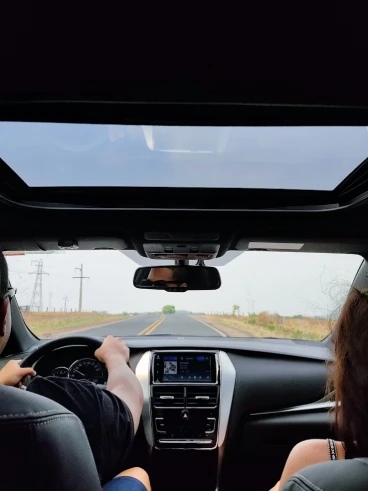
Infrared radiation from the sun passes through unprotected glass and heats everything it touches, your seats, dashboard, steering wheel and the air inside the cabin. A sunroof, being the largest single glass surface on your car’s roof, is responsible for a disproportionate share of this heat buildup. On a hot summer afternoon in cities like Ahmedabad or Hyderabad, cabin temperatures under an unprotected panoramic sunroof can exceed 60 to 70 degrees Celsius.
UV Damage to Your Interior
UV protection is not just for your skin. The ultraviolet rays that pour in through an unprotected sunroof slowly degrade your car’s interior, cracking the dashboard, fading the fabric or leather on your seats, and causing discolouration on plastic trims. This kind of damage is cumulative and, once it sets in, it cannot be reversed. It also directly affects your car’s resale value.
Physical Damage to the Sunroof Glass
Unlike side windows, your sunroof takes direct impacts from above — hailstones, falling tree branches, bird droppings, sap from overhanging trees and airborne debris on highways. Bird droppings in particular are chemically acidic and, when baked onto a hot glass surface, can cause micro-etching and permanent staining. Without a protective layer, all of this lands directly on the glass with no buffer.
Expert Trivia: Sunroof glass can reach surface temperatures exceeding 80 degrees Celsius on a peak summer day in India. At that temperature, bird droppings and tree sap bond chemically to the glass surface within minutes, making them nearly impossible to remove without leaving a mark.
Signs Your Sunroof Needs Protection
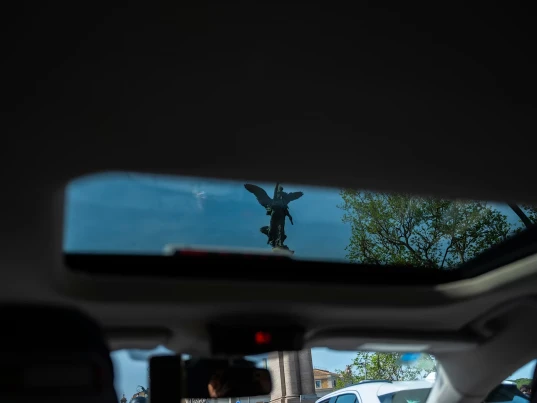
Not sure if your sunroof is already showing the effects of sun exposure? Here are the signs to look out for.
- Cabin feels unusually hot: If the area directly under your sunroof heats up much faster than the rest of the cabin, it is a clear signal that infrared heat is coming in unchecked.
- Interior fading or discolouration: Any yellowing, cracking or fading on the headliner, seats or dashboard directly beneath the sunroof points to UV exposure over time.
- Stains on the glass: Stubborn spots that do not come off with regular washing, especially white mineral deposits or yellowish marks, are signs of chemical etching from bird droppings or tree sap that has already bonded to the surface.
- Micro-scratches on the glass: Fine scratches that catch the light at certain angles suggest debris impact without any protective layer. These blur the clarity of the glass and worsen over time.
- Increased AC load: If your AC has to work harder and longer to cool the cabin, heat infiltration through the sunroof is often a contributing factor.
Best Ways to Protect Your Panoramic Sunroof
There are several ways to protect your sunroof from sun damage. Some work better than others, and the right solution depends on how much protection you are looking for and whether you want something permanent or temporary.
Install a UV Protection Film
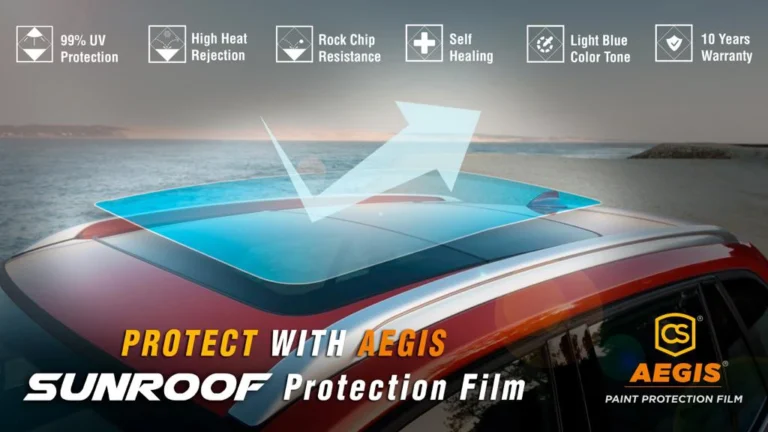
This is the most effective and long-lasting solution available. A sunroof protection film is a precision-cut sheet of premium TPU or ceramic-grade material applied directly onto the sunroof glass. It works on multiple levels simultaneously, blocking infrared heat, filtering out UV rays, shielding the glass from physical impacts, and keeping the surface hydrophobic so debris does not stick.
The key advantage of a sunroof film over every other option on this list is that it does all of this passively, without you having to do anything after installation. It is always working, whether the sunroof is closed, open, or the car is parked in the sun for hours.
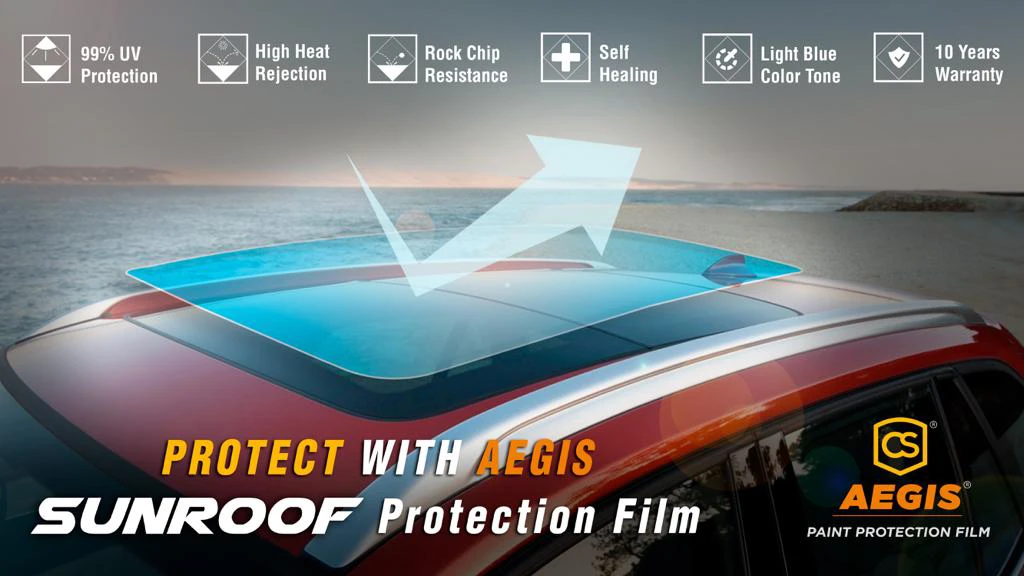
The Aegis Sunroof by CarzSpa is purpose-built for this job. Unlike regular window tints that are designed for vertical glass, the Aegis Sunroof uses premium TPU technology specifically engineered for horizontal surfaces, which face a completely different set of stresses. It delivers a 93% infrared rejection rate, blocks harmful UV rays, resists impacts from debris, and comes with self-healing properties, meaning minor scratches disappear on their own with heat activation. The film is optically clear, so your sky view stays completely unobstructed.
Use Sunroof Sunshades
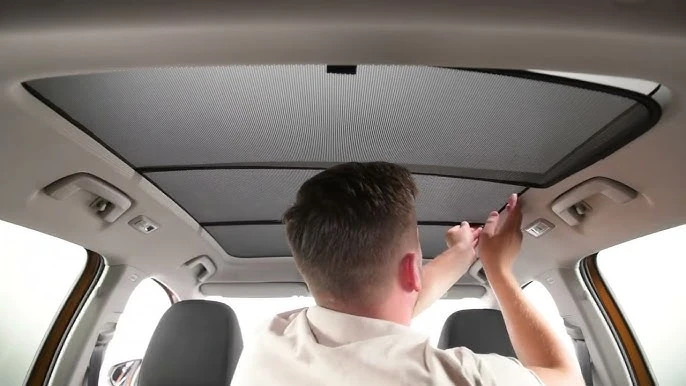
Sunshades are fabric or mesh panels that sit inside the cabin and cover the sunroof from below. They are a simple, affordable way to reduce the amount of direct sunlight entering the cabin when the car is parked. Most panoramic sunroofs come with a built-in sunblind that serves this purpose.
The limitation of sunshades is that they block visible light but do not stop the glass itself from heating up. The sunroof glass still absorbs all the solar energy and radiates heat downward into the cabin; the shade just delays how quickly you feel it. Sunshades are best used as a complement to a sunroof film, not a replacement for it.
Apply Heat Rejection Coatings
Ceramic-based spray coatings can be applied to the exterior of the sunroof glass to add a layer of heat and UV protection. These work by creating a thin, bonded layer on the glass surface that reflects and absorbs a portion of solar energy before it passes through.
Heat rejection coatings are a step up from sunshades, but they do not offer the physical protection that a film provides. They will not protect the glass from debris impacts, bird droppings or scratches. They also need to be reapplied periodically as the coating wears off. Think of them as a useful addition for a car that already has a film, rather than a standalone solution.
Park Smartly
This one costs nothing and makes a real difference. Whenever you have the option, park in a shaded spot, under a tree, in a covered parking bay or inside a basement. Parking in the shade can reduce cabin temperature significantly and cut the cumulative UV exposure your sunroof experiences over months and years.
That said, smart parking is not always possible. City driving in India rarely gives you the luxury of always finding shade, and your car still spends most of its life outdoors. Parking strategy works best alongside a more permanent protective solution.
Benefits of Protecting Your Sunroof
When you put the right protection in place, the benefits go well beyond just keeping the glass clean. Here is what you actually gain.
- A noticeably cooler cabin: With 93% infrared rejection, a quality sunroof film dramatically reduces the heat that enters through the top of your car. Your AC reaches the desired temperature faster, works less hard, and consumes less fuel in the process.
- Interior preservation: Blocking UV rays prevents the slow degradation of your headliner, seats, dashboard and trims. Your interior stays looking new for longer, and your car holds its resale value better.
- Glass protection: The film acts as a sacrificial layer between the glass and the world above. Debris, bird droppings and minor impacts hit the film first, not the glass. If the film gets scratched, it can be replaced. Sunroof glass replacement is expensive.
- Self-healing surface: The Aegis Sunroof films are made with Thermoplastic Polyurethane (TPU, means light scratches from dust and debris disappear with heat.
- Hydrophobic surface: A treated sunroof surface repels water and prevents contaminants from bonding easily. This makes the sunroof easier to clean and less likely to develop stubborn stains.
- Peace of mind: A 10-year warranty means you are not making a short-term decision. The protection is built to last the life of your car under Indian conditions
Common Mistakes to Avoid
Car owners trying to protect their sunroof often make a few avoidable mistakes. Here is what to watch out for.
Using a standard window tint on the sunroof
Window tints are designed for vertical glass. Horizontal surfaces face different stresses, gravity, water pooling, higher impact loads from above and a film not designed for this will bubble, peel and fail much faster on a sunroof.
DIY film application
Applying a film on a curved, horizontal glass panel is one of the most technically demanding jobs in car care. Air bubbles, uneven adhesion and improper edge sealing are common outcomes of DIY attempts, and they reduce both the performance and the lifespan of the film significantly.
Ignoring the curing period
After a sunroof film or coating is installed, the adhesive needs time to cure and fully bond with the glass. Washing the car, parking in the rain or operating the sunroof too soon can disrupt this process.
Using harsh chemicals to clean the sunroof
Ammonia-based glass cleaners and abrasive sponges break down protective coatings and film adhesives over time. Always use ammonia-free cleaners and a soft microfibre cloth.
Waiting until damage appears
UV degradation and heat damage are cumulative. By the time you can see the effect, faded seats, a cracked dashboard, stained glass and a significant amount of damage have already been done. Protection installed early is always more effective than a repair attempted later.
Legal Considerations in India for Sunroof film
If you are wondering whether applying a sunroof film or a moonroof film runs into any legal issues in India, the answer is straightforward: it does not, as long as the film maintains adequate visible light transmission.
The Supreme Court’s 2012 ruling and CMVR Rule 100(2) govern Visible Light Transmission (VLT) requirements for car glass. These rules are primarily focused on side windows and windshields, with 70% VLT required for front and rear windshields, and 50% for side windows. Sunroofs are not specifically covered by these restrictions in the same way.
That said, the practical guidance is the same: choose a film that maintains optical clarity and does not obstruct the driver’s field of vision in any meaningful way. The Aegis Sunroof is optically clear by design; its job is to protect and reject heat, not to darken the glass. You get full protection with zero compliance concerns.
Professional vs DIY Protection
It is tempting to look at DIY sunroof protection kits available online and think you can save some money by doing it yourself. But sunroof installation is genuinely one of those jobs where professional installation makes a significant difference in how the film performs, how long it lasts, and whether it actually protects your glass.
Here is an honest comparison.
| Factor | Professional Installation | DIY |
|---|---|---|
Surface preparation | Full decontamination and prep protocol | Typically skipped or rushed |
Film quality | Premium TPU grade, purpose-built for sunroofs | Generic kits of variable quality |
Application accuracy | Precision cut and fitted to your specific sunroof dimensions | Manual cutting with risk of misfit |
Bubble and crease risk | Specialist tools and trained technique eliminate air pockets | High risk without proper tools |
Edge sealing | Complete edge sealing to prevent lift and contamination | Often incomplete, leading to peeling |
Warranty | 10-year product and installation warranty | No warranty in most cases |
Legal compliance | Verified by certified professionals | Unverified |
The Aegis Sunroof is exclusively installed at CarzSpa Detailing Studios across India and Nepal. CarzSpa’s certified technicians are trained specifically for horizontal surface applications, with the precision measurement, cutting and edge sealing techniques that a panoramic sunroof demands. This is not a job for a general workshop, and it is certainly not a job for a first-time DIY attempt.
Aegis Sunroof PPF - Specifications and Pricing
Here is a quick overview of what the Aegis Sunroof delivers and what it costs at CarzSpa studios.
- Material: Premium TPU (Thermoplastic Polyurethane)
- Infrared Rejection: 93%
- UV Protection: 99%
- Self-Healing: Yes, minor scratches disappear with heat activation
- Surface: Hydrophobic coating for effortless maintenance
- Optical clarity: Crystal-clear and no darkening of the sky view
- Warranty: 10 years
As one of the best PPF brands in India, Aegis Films offers sunroof protection in three size packages to accommodate different vehicle types.
| Vehicle Type | Sunroof Size | Price |
|---|---|---|
Small | 15 sq.ft. | Rs. 9,000 |
Medium | 25 sq.ft. | Rs. 15,000 |
Large | 35 sq.ft. | Rs. 21,000 |
Additionally, if you also want to address the heat and UV coming in through your side windows and windshield, pairing the Aegis Sunroof with Aegis sun control film, either the K70 Carbon or CX70 Ceramic, gives you complete, whole-car sun protection from every angle.
Expert Trivia: Because sunroofs are horizontal, they experience nearly double the solar intensity compared to side windows. The sun’s angle is near-perpendicular to the glass for several hours each day, which is why a purpose-built sunroof PPF with a 93% infrared rejection rate makes such a dramatic difference to cabin temperature — far more than a standard window tint ever could.
Conclusion
Your panoramic sunroof is one of the most beautiful features of your vehicle, but it requires the right protection to truly shine. By investing in a high-quality sunroof film, you aren’t just lowering the temperature of your car; you are protecting your skin, your car’s interior and your wallet from expensive glass repairs. Choose sunroof films made by Aegis Films, one of the best PPF brands to experience the open feeling without the downsides of the sun. Don’t let the Indian summer turn your luxury ride into a furnace. Head to a professional detailing studio and give your panoramic roof the shield it deserves.
Frequently Asked Questions
1. Does sunroof film make the cabin too dark?
No, modern films like Aegis Sunroof are designed to be high-clarity. They block heat and UV rays while allowing most visible light to pass through, preserving the airy feel of your panoramic roof without the glare.
2. Is PPF better than normal sun film for a sunroof?
Yes, for panoramic roofs, PPF is superior. While standard sun control film only blocks heat, PPF (like Aegis Films) provides a thick TPU layer that protects the glass from physical impacts like stones and debris.
3. Can I open my sunroof after the film is installed?
You should wait at least 48 hours after installation before opening your sunroof. This “curing” period allows the adhesive to bond perfectly, ensuring the film doesn’t peel or catch in the mechanism.
4. Does the film help with AC efficiency?
Absolutely. By rejecting up to 93% of infrared heat, a sunroof protection film prevents the cabin from heating up. This allows your AC to cool the car faster and maintain the temperature with less effort.
5. How long does a premium sunroof film last?
High-end options like Aegis Films come with a 10-year warranty. They are engineered to resist yellowing, cracking, and peeling, even under the constant, intense sun exposure typical of the Indian climate.
Share: